In this BNI Education Slot, Darren Jamieson explains how members can use Facebook groups to attract visitors without relying on obvious promotional posts.
His main message is simple: stop advertising BNI and start giving business owners a genuine reason to attend.
Darren begins by showing examples from a local business Facebook group. Many of the pending posts are basic adverts containing phone numbers, business details and little useful context. Some have been shared from private profiles, meaning group members cannot even view the original content.
He explains that posts like these rarely generate results. Groups that allow unlimited promotion quickly become filled with spam, while moderated groups often reject or ignore obvious adverts.
The same principle applies when promoting BNI. Posts about weekly meetings, visitor fees and networking are unlikely to appeal to people who do not already understand the organisation.
Darren demonstrates a better approach using a post aimed at local business owners. Rather than mentioning BNI, he focused on how lonely running a business can feel and invited people to attend a relaxed breakfast with others in a similar position.
The post mentioned support, conversation, coffee and breakfast, alongside attractive photographs of the venue. It did not mention networking, weekly meetings or 60-second presentations.
The post received 17 comments, with people expressing interest, asking questions and tagging other business owners. Darren explains that it worked because the message focused on the reader’s needs rather than the meeting itself.
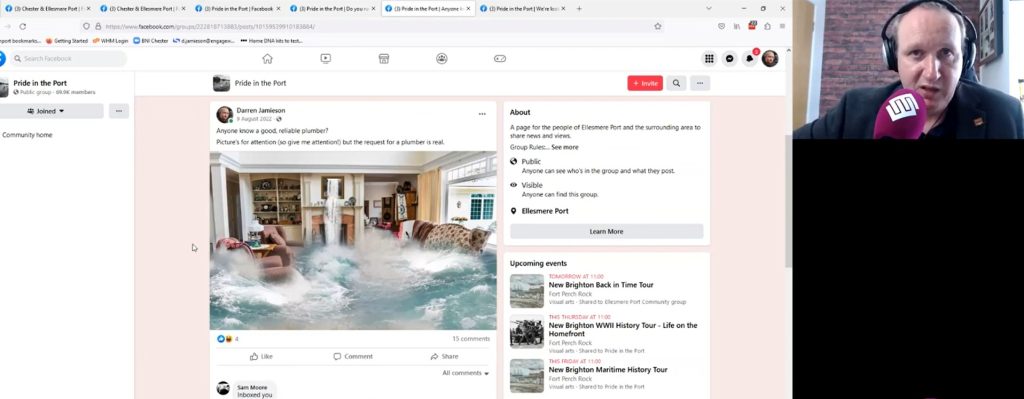
Another method involves asking group members to recommend a particular type of business. Darren shares an example of a post asking for a good, reliable plumber. The short message and attention-grabbing image led to numerous plumbers being tagged and recommended.
At the time, his BNI chapter had a vacancy for a plumber, so every recommendation became a potential visitor. However, Darren did not immediately invite them to a networking meeting.
Instead, he contacted each person, explained that they had been recommended and asked whether they worked with letting agents. He then offered to introduce them to a letting agent he was meeting at an upcoming business event.
The invitation centred on a valuable connection rather than BNI itself.
Darren also describes how his company used Facebook to find a cleaner for its office. The genuine request included photographs of the building and details of the work required. It generated 76 comments, with cleaners being recommended and several contacting him directly.
Darren invited suitable businesses to discuss the opportunity with him at a business referral meeting. Several attended, and one visitor later applied for BNI membership. Her company also secured the office-cleaning work.
A few months later, she admitted that she would not have attended if Darren had originally told her it was BNI or that she would need to deliver a 60 Seconds.
Once she experienced the meeting, however, she enjoyed it, joined and began receiving business through the chapter.
Darren concludes that successful visitor invitations should focus on helping the person being invited. That could mean offering an introduction, a potential work opportunity, useful support or access to other business owners.
Rather than advertising BNI terminology, members should explain why attending could be valuable to that particular person. When the invitation is built around their needs, they are far more likely to attend and discover the benefits of BNI for themselves.
Full Transcript
[00:14]
What I’m going to share now is a couple of tips for inviting visitors to BNI using Facebook.
Now, before I do this, I want to show you what not to do—what most people do—and that’s to go into Facebook groups and essentially spam them about BNI, or even about your own business.
It absolutely does not work.
[00:42]
It’s just a load of spam.
For example, here we’ve got a Facebook group that I’ve created, one that I run for our local area, Chester and Ellesmere Port—the ideal hunting ground to bring businesses from the group into your BNI group.
[01:00]
As you can see up here, there are 2,800 members in this group.
I’ve got a lot of pending posts in here because people go into the group and try to spam it.
[01:14]
If I go into the pending posts—pending approvals—it says 20-plus. There are probably about 200 in here. There are definitely more than 20.
If we go through here, this guy has posted about professional carpet and sofa cleaning. There’s his phone number. There’s his address.
[01:34]
He’s shared something, probably from another post that he has put somewhere else, but it says the content is not available at the moment.
That means his previous post was probably friends-only, which he has then shared into a group. He can’t share it into a group because it isn’t public.
So, you get posts like that.
[01:49]
These are people who have no idea how to use social media. They’re sharing private posts in a group and thinking it is going to work.
Michelle Rice has done exactly the same thing.
[01:57]
She has shared a post with no text, no accompanying commentary and no idea what it was, because it was shared from a private, friends-only post or from another group that doesn’t allow posts to be shared externally.
She has just wasted her time sharing something that no one can see.
[02:15]
Hareacre Church Farm has just shared some pictures of its venue and said, “Come down and have a look. There’s more on every table.”
It is basically just promoting the business.
Nobody cares.
[02:31]
Jamie Art is sharing asbestos removal. “Jamie Art” doesn’t even make sense.
“Asbestos-removal specialist”—it is just an advert for the business.
That is what most people do.
[02:38]
If a group allows posts like that to be shared, then it is essentially just full of adverts and spam.
Nobody is in there to find out what you do. Nobody is in there because they are interested. They are just in there to share their own posts.
[02:53]
You are not going to get any kind of business or traction from posts like that.
If you do it in a group that doesn’t allow advertising, your post is just going to be unapproved, like mine are here. They are all pending.
[03:08]
I’m not going to approve them, and you are just wasting your time.
Yet most people do Facebook advertising like this. This is how they go into groups and advertise their businesses.
[03:19]
Let me show you how you do it.
This is a local Facebook group to us, Pride in the Port. Anybody from Ellesmere Port will be aware of this group.
[03:31]
There is a lot of toxicity in this group, as there is, I imagine, in a lot of local Facebook groups. You have to take that with a pinch of salt.
As you can see up here, there are just under 70,000 members in this group, so it is very active.
[03:47]
Whatever you think of local Facebook groups, whether you like them or not—and let’s face it, most of us don’t—there are a lot of people in them.
There are a lot of people in there who are potentially business owners or in decision-making roles within businesses and could be potential visitors for your BNI.
[04:09]
One way I got a lot of visitors to a chapter—which was actually a core-group chapter rather than my own BNI Chester—was, rather than sharing information about BNI, talking about BNI and talking about the weekly meeting, to share what you can gain from going and not even mention that it was BNI.
[04:27]
Here is a post I made in one of those groups:
“Do you run your own business?
“Being in business for yourself can be really lonely, especially if your social circle aren’t business owners and don’t understand what you are going through.
[04:46]
“We’re holding another business owners’ breakfast meeting tomorrow morning at the fabulous Port & Anchor Eatery in Ellesmere Port.
“Are you a business owner who would like to come down, meet some other business owners in the same boat—pun intended—share what you do in your business, and have some great coffee and a fabulous breakfast too?
[05:02]
“You do have to be in business, and numbers are limited because of the space, so message me or comment if you would like to come along tomorrow morning, Wednesday the 31st of August.”
I put in some photographs from the previous week’s meeting.
[05:18]
The venue is particularly attractive. It is on the side of the Manchester Ship Canal, so you get some beautiful, very large ships being towed by tugs on there.
We got some great photography, so that helps. That makes it stand out.
[05:26]
The important thing is that it focuses on you.
Again, this is a theme for what I am going to be showing you.
“Do you run your own business? Being in business can be lonely.”
I have not mentioned BNI.
[05:43]
I have not mentioned networking, I don’t think, either. No, I haven’t.
I have not mentioned “weekly”. I have not mentioned anything about that.
It is: “Do you run your own business? Isn’t it lonely in business? Do you want to come along for some support?”
[05:56]
We had 17 comments on that.
Andy’s Garden Services said, “Definitely interested in the next one that you do.”
We have another one down here asking, “What time is it on?”
These people are asking questions.
[06:15]
They are asking questions, and people are being tagged in it.
“Hey, you run a business. Why don’t you come along?”
This is working. I am getting visitors from this, and I am replying to each one of these and inviting them along to the meeting.
[06:29]
I did this a few times over the space of a couple of months, and it works because I am advertising the meeting, but I am not making it obvious that I am advertising a meeting.
I am advertising help for people who run a business—people who are in business.
[06:43]
This is the way to do it.
You are putting together a striking image and offering support to people who need support.
Not: “Hey, come and meet at our BNI venue. Come and go to our weekly meeting. This is going to be great. You are going to love it. It’s £15,” or whatever it is.
That does not work.
[06:59]
Let me show you another example of something that I have done.
This is what I call—pardon the pun again—fishing for members in a particular category.
[07:12]
“Anyone know a good, reliable plumber? Picture for attention.”
So, give me attention—but the request for a plumber is real.
There is a lovely photograph I found on Google of a flooded house.
[07:27]
Naturally, because the image has got attention, the message is really short:
“Anyone know a good, reliable plumber?”
If anybody is friends with a plumber, they are going to tag them in.
[07:37]
We have: “Inbox.” “Steve Cox is excellent.” “RCD Plumbing.” “Phil Tomlinson.”
Somebody has put a screenshot of an image on their phone of a van.
There is no helping some people.
[07:48]
Joshua Harding, Elegance Plumbing, Peggy Plumbing, Elegance Plumbing again, Doolie’s Plumbing, First Class Plumbing, Elegance, Elegance, Elegance, VF Heating and Plumbing.
[08:02]
People are tagging these plumbers.
[08:05]
I didn’t message those plumbers and say, “Hey, come along and give me a quote for this.”
Every single one of those was invited to BNI because we had a vacancy in our chapter at the time for a plumber.
[08:20]
Again, when I messaged those people, I didn’t message them and say, “Do you want to come along to BNI? Do you want to come along to a networking meeting?”
No, no, no.
[08:29]
I messaged each one of those people, and the message was something along these lines.
For example, Steven Hartley has recommended Steve Cox. I would have messaged Steve Cox and said:
“Hey, Steve. You were recommended as a great plumber in the Facebook group Pride in the Port.
[08:49]
“Do you do a lot of work for letting agents?”
That was it.
“Do you do a lot of work for letting agents?”
At that point, Steve Cox would have replied with either, “Yes, I do,” or, “No, I don’t, but I would like to.”
[09:07]
The reply back then is:
“Excellent. I’m meeting a letting-agent friend of mine on Thursday morning at Rowton Hall in Chester.
“Would you like to come along, and I can introduce you to him? He might be able to find you some work.”
[09:17]
I am not inviting them to BNI. I am not inviting them to a networking meeting. I am not inviting them to a weekly meeting.
I am inviting them to come along because they have been recommended to meet somebody who can give them work.
[09:35]
That works.
Let me show you an example of another one that I have done.
[09:39]
This one directly resulted in getting a member.
Again, in the group Pride in the Port—69,900 people—and this was last year:
“We’re looking for a cleaner who can do regular cleans of our office on Rossmore Business Village.
[09:56]
“You can see from the photos there are two floors, with a training room and meeting room, and we need someone reliable who can do the whole interior regularly.
“If you can recommend someone, please let me know.”
[10:03]
There is a photo of the front of our office with our funky sign on the building and some pictures of the interior, which is obviously advertising our business via the back door—surreptitiously putting our branding in there.
[10:12]
I have not posted, “Hey, we’re Engage Web. Look at all the cool stuff we do.”
I have just put a picture of our office and said where it is. It is clear what we do, but I have been subtle about it.
[10:29]
Seventy-six comments.
Seventy-six comments, with people tagging all of the different cleaners, and cleaners messaging me directly as well.
Look at that—all of those cleaners coming to me.
[10:46]
I’m still scrolling. All of them.
Wow, that’s incredible.
[10:50]
That was because we genuinely needed a cleaner. We genuinely needed someone to clean the office.
There wasn’t anyone in our BNI chapter.
[10:57]
I could have gone to a chapter in the wider region. I could have gone to one of the other BNI chapters in the area and found out whether there was a cleaner there.
Or I could have gone a bit further afield, because we are on the border with another region.
[11:04]
I could have gone into one of the North Wales chapters or one of the Merseyside chapters.
I thought, “No, I’m not going to do that. I’m going to find a cleaner using social media.”
[11:13]
Every single one of those who replied—I could have replied and said:
“Hey, this is our address. Book a time with our office manager, come in, have a look and quote for doing the clean.”
[11:29]
Loads of cleaners would have turned up and quoted for it—more than we needed, obviously.
But I didn’t do that either.
No.
[11:40]
Instead, I messaged every single one and said:
“Hey, you were recommended as a cleaner in Pride in the Port. My company is Engage Web. We’re looking for somebody to do a clean.
[11:48]
“Are you able to meet me at a business-referral meeting on Thursday morning at Rowton Hall at 6:45 in the morning? I can talk to you about the office cleaning that we need there.”
[12:03]
Obviously, a lot of them didn’t reply because a lot of them were one-person businesses that couldn’t cope with that kind of time in the morning or couldn’t cope with a commercial clean across two floors.
[12:12]
Some replied and didn’t want to do that time in the morning because they had children.
Some replied and said they would be there but didn’t turn up.
Some replied, said they would be there and did turn up.
[12:25]
We got half a dozen—four or five, maybe—visitors out of it, just from that one social-media post.
One of them actually applied and joined as a member. She is now cleaning, and is still cleaning, our office every fortnight.
[12:44]
What is particularly interesting is that I did an Education Slot a couple of months later about this particular technique of inviting visitors.
The lady who joined as a member is on these comments down here—a lady called Natalie from 247 Sparkle Clean.
[12:58]
She said to me in the meeting, during the Education Slot, in front of everybody:
“If you had told me it was BNI and I had to do a 60 Seconds, I would not have come. I would not have gone.”
[13:13]
I think that speaks volumes because a lot of people are worried about it.
A lot of people are put off by the idea of going to a networking meeting. They are put off by the idea of doing a 60 Seconds and put off by the idea of talking in front of others.
[13:22]
But when she came, saw it and did it, she loved it.
She applied, she joined and she gets a lot of business out of it.
[13:33]
That is the important thing.
Don’t tell people they are going to a BNI meeting.
Don’t tell people they are going to a networking meeting.
Don’t tell people it is weekly.
[13:42]
Tell people they are going there because you want them there to help them.
You are giving them work, or you are introducing them to somebody who is going to help them.
That is how I did it in this particular instance.
[13:54]
That is how you should do it across social media, particularly across Facebook.
You are helping people. You are offering support to people.
You are not inviting them to BNI.


 Subscribe for the latest BNI Education Slots