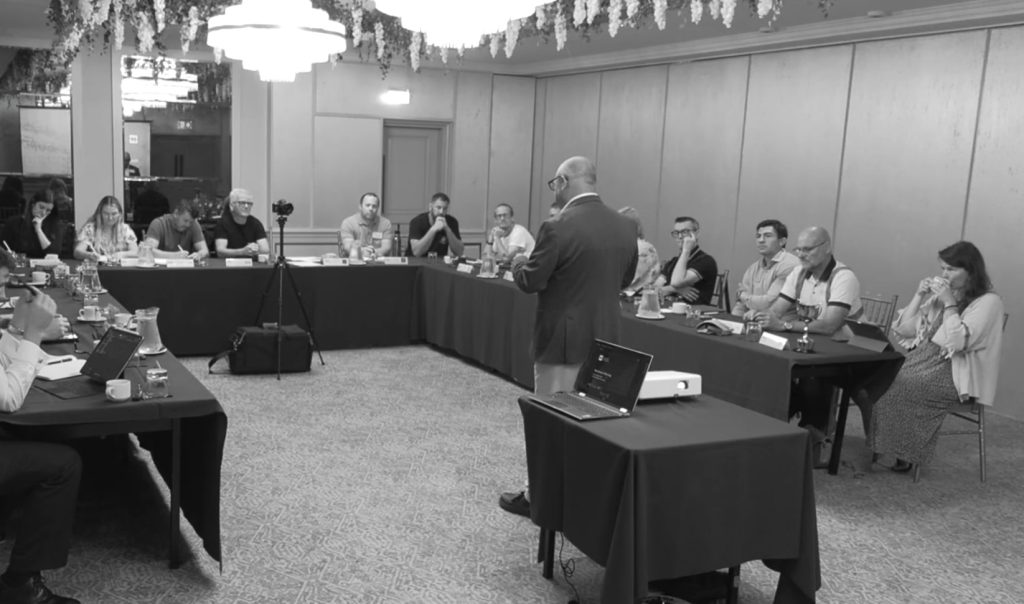
When a visitor attends a BNI meeting, it can be tempting to immediately think about whether they might become a customer or perhaps a future member of the chapter. In this BNI Education Slot, Sauren Ghosh encourages members to look beyond that immediate opportunity and consider something potentially much more valuable: the visitor’s wider network.
Sauren explains that the objective should not be to sell to visitors. Instead, members should concentrate on helping visitors get as much value as possible from their BNI experience, even when they are only attending a single meeting. Every visitor, guest or substitute who enters the room brings a network of their own, consisting of customers, suppliers, friends, relatives, colleagues and other business contacts.
That network can be relevant regardless of whether a BNI member operates in a business-to-business or business-to-consumer market. Sauren uses his own Utility Warehouse business as an example, where homeowners are an important audience. The individual visitor may or may not fit that description, but there could be many people within the visitor’s network who do.
This requires a change in thinking. Rather than asking how a member can sell something to the visitor, Sauren suggests considering how they can build a relationship with that person. One strong relationship has the potential to create multiple opportunities over time, with the benefits working in both directions.
Curiosity plays an important role in developing those relationships. Sauren describes himself as someone who asks a lot of questions, partly because he is interested in people but also because questions can reveal opportunities to create value. Asking somebody what they do is only the beginning. Questions such as what sort of customers they are looking for and who would be a particularly useful person for them to meet can lead to much more productive conversations.
He illustrates how this works through the conversations he regularly has with other members. By knowing who somebody else wants to meet and understanding the meetings taking place within his own network, Sauren can identify opportunities to make introductions. Those introductions may develop into business even when the original conversation appeared to have little immediate commercial relevance.
Sauren describes this wider way of thinking as the “visitor multiplier.” If five visitors attend a meeting, members could simply see five people they might potentially sell to. A more powerful approach is to consider all the people contained within the networks of those five visitors. Suddenly, the scale of the potential opportunity becomes significantly larger.
The aim is therefore to create mutually beneficial connections rather than pursue individual transactions. A one-off customer can be valuable, but a strong relationship with someone who understands what a business does and knows who it wants to meet can create a continuing flow of relevant introductions.
Sauren finishes with a simple challenge. The next time a member speaks to a visitor over breakfast — or even catches up with an existing member they have not spoken to recently — they should ask one question: “Who are you looking to meet?”
The answer could lead somewhere completely unexpected, because the next great customer might only be one connection away.
Full Transcript
0:17
Morning all. Morning.
0:19
You’re also supposed to stop and poise yourself before you get started. Good morning, everyone.
0:26
All right. So today I’m going to talk about how to earn money from BNI visitors.
0:33
But don’t worry, Paul. Don’t worry, James. This is not a selling spiel. That sounds a bit mercenary, doesn’t it? But it really is about helping visitors to get the most out of their BNI journey, even if they’re just here for one meet. And I hope, of course, they see the benefit and want to be part of this amazing, amazing group.
0:51
So our job is not really to sell to them, but a visitor is an opportunity on so many different levels.
1:01
Um, you get to think about the type of customers who they might be able to lead you to.
1:08
Who are they currently working with at the moment? Who are their suppliers? Who are their friends, family and colleagues? Because some people in the room here are operating on a B2B level and others are operating on a B2C — business to consumer, to customers.
1:25
Uh, in my case, with my Utility Warehouse business, I’m looking for homeowners, as you know. But the key thing is everybody who walks through the room — visitors, guests, substitutes — they’ve got a network.
1:41
And that network may be full of people that you can help, but also they could benefit from the services and products that you have. So we have to reframe things a little bit.
1:52
So instead of thinking, “How can I sell to that person?”, have a think about, “How can I build a relationship with that person?”
2:00
Because one good relationship could lead to lots and lots of business for you and, equally important, for them.
2:10
So stop selling. Start being curious.
2:13
Some people in the room will know I ask a lot of questions. Is it because I’m nosy?
2:18
It is actually, a little bit. Thank you, Kieran. Um, it’s partly that I’m interested in people, but it’s also to see if we can add value. So, sort of things you could ask is, “What do you do?”
2:29
Okay, so I asked James that because I’ve forgotten. I didn’t know, by the way, but I just wanted to hear it from you. So there might be opportunities there when we have a chat about air conditioning, home utilities. So, quite interesting.
2:43
What about this question? “What sort of customers are you looking for?” Because if you ask that question, you might get the opportunity to develop something.
2:51
So, I’m always chatting. Gail and I chat a lot, and I always tell her who I’m meeting and what I’m doing. There might be an opportunity for Gail in those meetings. I’m meeting a guy later this morning and I’m going to introduce Gail into that conversation with a possible meeting, because you just don’t know where these conversations are going to go.
3:08
Who’d be a really useful person for you to meet? I’d like to think that when we all walk through the room — through the door into the room — we’ve got goals about how we’re going to grow our business. We have a strategy. Who we’re going to talk to. Who’s going to lead us to our ideal customer.
3:24
And this is what we could call, I guess, the visitor multiplier. I always think of The Big Bang when I hear of things like that. Some of you won’t know what I’m talking about. Some of you will.
3:31
But imagine we have five visitors at a meeting and everybody thinks, “There’s five people I can sell to.”
3:40
What about the network that those people have?
3:44
Our job, I suppose, if we’re growing our business, is how we can make it mutually beneficial to get in front of those people on a mass scale.
3:51
One-to-one customers are great, but wouldn’t it be good if you had a steady flow of people wanting to know about you and your services?
4:00
So, it’s really the relationships and the connections we’re trying to develop.
4:07
So, next time you’re speaking to a visitor or somebody over breakfast — maybe it could be a member even you’ve not spoken to for a while — just ask them a simple question: “Who are you looking to meet?”
4:19
And who knows? Your next best customer might just be around the corner. Thank you.


 Subscribe for the latest BNI Education Slots